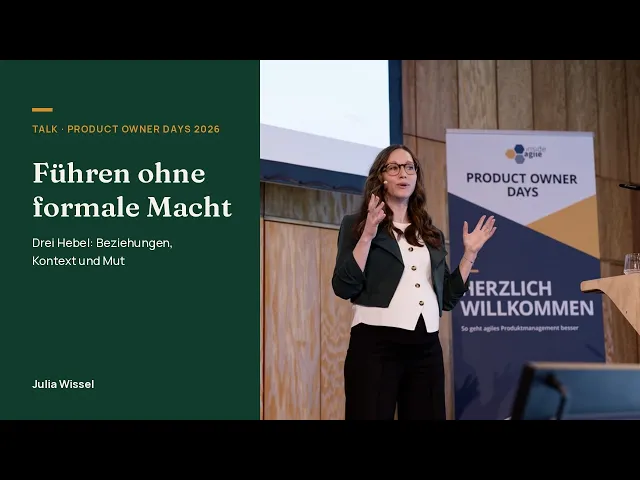
TALK
·
BEYOND THE SILO
·
Most of us know the moment. You walk into the meeting well prepared – the facts in order, the better arguments ready – and the decision goes another way. Or it doesn't happen at all.
What we conclude from that moment matters more than the moment itself. Usually it is one of two things: next time, bring more data. Or: I'm simply not in the right role to influence this. Both lead in the wrong direction.
This was the starting point of my talk at Product Owner Days 2026 in Cologne. Across startup, corporate, agency and now product work at MOIA, the pattern has been consistent: the hardest decisions rarely sit inside a team. They sit between teams, functions and departments – exactly where nobody holds formal authority over everyone involved.
“If you wait for formal power, you'll never lead.”
Leadership is not hierarchy
Most of us were socialised with a simple rule: whoever sits higher decides. And healthy hierarchy is needed – for governance, for legal reasons, and for strategic bets with truly significant consequences for the company. Not everything can or should be decided by consensus.
But between those cases lies a wide space of decisions that can be shaped from anywhere: bottom-up, across, top-down. This is where different kinds of expertise meet. In that space, leadership comes from influence rather than title. And influence is a form of power – informal, but real.
The problem with the word “power”
Power has a bad reputation. Control, hierarchy, abuse – none of these words sound good. In product organisations especially, people prefer to talk about autonomy or room to shape things. Power itself is something many would rather not have.
But power is not the problem. What it is used for is. The relevant question is never whether someone has power – everyone has it in some form. The question is how it is used. Whoever doesn't use it leaves the field to someone else. Not always in their own interest, and not always in the interest of a good decision.
Three levers turn this into practice: relationships, context and courage.
Lever 1: Relationships
Game of Thrones is, seriously, a good model for how power works in organisations. Rarely through bloodline. Mostly through alliances, loyalty and trust. Who convinces whom, who blocks a decision, depends less on the org chart than on whom people trust.
Most teams know the stakeholder map. Its limitation: it usually follows the org chart. A second layer helps – an influencer map. It asks who the decision-maker actually calls before deciding, and it adds accelerators, champions, sceptics and saboteurs. The reflex to route around sceptics is the wrong one. Involving them earlier and taking their doubts seriously works better.
I learned this the hard way. At MOIA, a topic of mine stalled for weeks in our Decision Circles despite solid preparation: new questions every time, more data requested. I had focused on the most senior stakeholder – not on the person they trusted, who didn't feel comfortable admitting in the large group that the KPIs weren't clear to them. Once that person was involved, the decision came two weeks later.
Relationships are not a soft skill. They are decision infrastructure – and infrastructure needs maintenance, not a one-off build. Watch from 07:07
Lever 2: Context
The word comes from the Latin contexere, to weave together. Context does not simply exist. It has to be created, so that others can follow the reasoning at all.
Without it, an opinion becomes the decision. The HiPPO effect – the highest paid person's opinion – describes exactly this: the most senior voice in the room is usually the loudest, not necessarily the best informed. Without an alternative, it still becomes the basis for the decision.
Context doesn't mean knowing everything. It also means making visible what you don't know yet. An assumption map does this well: how much do we know about an assumption, and how urgently do we need to find out? It makes assumptions visible and prioritisable – and tells stakeholders their hypothesis has been heard, just not validated yet. The discussion shifts from “what should we do” to “what do we actually know”.
Decision papers follow the same logic: as concrete as possible, ideally a clear yes/no or A/B, short, and presented objectively. Take a simple trade-off. Feature A takes six weeks and brings €50,000 in mid-term revenue and 15% more retention. Feature B ships now, brings €200,000 short-term, but costs 8% retention. The right recommendation depends entirely on what the company is optimising for – and that only becomes visible once the trade-off is on the table.
This is where good product managers differ from average ones: not in how many decisions they make within their own circle of control, but in how many decisions they enable beyond it. Ideas don't win because they are good. They win because they are understood. Watch from 12:21
Lever 3: Courage
After all the relationship work, one misunderstanding is close at hand: that the goal is to be liked. The opposite is true. The easy, uncontested decisions are rarely the ones with the most impact. Usually it's the unpopular ones – with peers as much as with management.
Courage doesn't mean being loud or dominant. It means naming what is already in the room but nobody says. A simple check: Which conflict am I avoiding right now? Whom would I like to contradict? And what would I do if I weren't afraid of being unpopular?
That last question became personal when I moved from product manager to director. Long-time peers became my team overnight. Worried about losing the standing I had built, I held back unpopular opinions – until it became clear that this was hurting the team, the company and my role. Speaking up taught me two things. The reaction is rarely as bad as feared; more often there is gratitude. And sometimes someone doesn't speak to you for two days. That hurts, but it is a legitimate, temporary reaction. The work moved forward anyway.
Avoiding conflict means avoiding impact. Watch from 19:21
How the levers connect
Relationships form the decision infrastructure, as long as they are maintained. Context makes decisions understandable and possible. Courage is what turns both into impact.
None of this is limited to product owners or product managers. It applies to anyone working between systems, teams and functions rather than inside a single area of responsibility. And it can be tried out at low risk: in most of the places we work, nobody dies when a decision turns out to be wrong.
“You don't need formal power to lead. But you have to stop waiting until you get it.”
Leading without formal power doesn't mean less responsibility. It means more – for the quality of other people's decisions.
This talk was given at Product Owner Days 2026 in Cologne, organised by inside agile. The next edition, Product Owner Days 2027, is open for registration.